
Menopause symptoms: Why hot flushes are only part of the picture
Symptoms are complex, with patterns that shift across pre-, peri- and post-menopause.
For decades, the medical and media conversation around menopause has centred on hot flushes and night sweats (vasomotor symptoms). These vasomotor symptoms are absolutely central to the story and can be disruptive, but more recent research confirms that they are only part of the story.
A recent study analysing over 145,000 symptom logs from nearly 5,000 women provides a much broader view of how symptoms evolve across the reproductive life course. The findings challenge the idea that menopause symptoms follow a simple pattern and highlight just how varied women’s experiences can be.
What the Study Looked At
Researchers analysed data from women using a digital symptom-tracking app. The dataset included:
4,789 participants
147,501 symptom reports
45 different symptoms
Participants were classified as premenopausal, perimenopausal, or menopausal, allowing researchers to examine how symptoms cluster and change across these stages. Menopausal stage was determined using self-reported menstrual cycle patterns recorded in the symptom-tracking app; women reporting regular cycles were classified as premenopausal.
Rather than focusing on single symptoms, the researchers used statistical modelling to identify symptom clusters, groups of symptoms that tend to occur together.
Distinct Patterns Across Life Stages
Life stage timeline
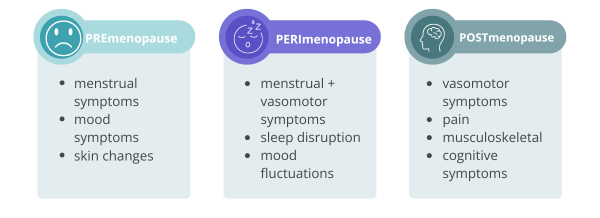
The analysis showed that symptom patterns differ across reproductive stages.
Premenopause
Common clusters included:
Menstrual symptoms (cramps, breast tenderness)
Digestive symptoms
Mood symptoms
Skin and hair changes
Perimenopause
This stage showed a mix of menstrual and other menopausal symptoms, reflecting the hormonal fluctuations that occur during the transition. Women often experienced both:
Cycle-related symptoms
Vasomotor symptoms such as hot flushes
Postmenopause
Symptom patterns shifted toward:
Vasomotor symptoms
Pain and musculoskeletal symptoms
Cognitive symptoms
Mood changes
These patterns reinforce something many women already know: the transition is not neat or linear and symptoms overlap across stages.
Some Symptoms Are Common at Every Stage
Symptoms across all stages
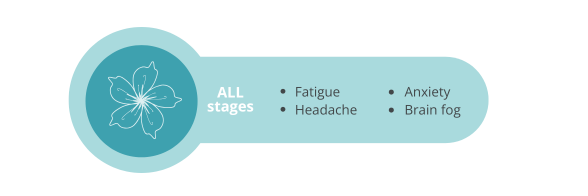
A really important finding was that several symptoms appeared consistently across all life stages, including:
Fatigue
Headache
Anxiety
Brain fog
These symptoms were among the most frequently reported regardless of menopausal stage. This suggests that focusing exclusively on reproductive hormones and period-related symptoms may miss a large part of the picture.
Where do hot flushes fit?
Another interesting finding was that hot flushes were not strongly predictive of other symptoms. Instead, the only symptom that reliably clustered with hot flushes was night sweats.
In other words, if someone experiences hot flushes, that doesn’t necessarily mean they will experience the other commonly discussed menopause symptoms. This challenges the idea that vasomotor symptoms are the central feature of menopause for everyone.
Why this is important
If you see your healthcare professional and they mainly (or only) focus on vasomotor symptoms, they risk overlooking a large proportion of women’s symptom burden. As above, the study authors note that many women experience mood, cognitive, digestive, skin, and nervous system symptoms during the menopausal transition.
These symptoms can have a significant impact on:
work
relationships
mental wellbeing
quality of life
A More Whole-Person View of Menopause
This research reinforces a broader message and how I work with women: menopause is a whole-body transition.
Hormonal changes interact with:
metabolic health and digestion
sleep
stress physiology
mental health
cognition
inflammation
genitourinary
lifestyle factors
Understanding menopause through this wider lens allows for more personalised care. For some women, their biggest, nastiest symptom may be hot flushes. For others, it may be anxiety, fatigue, cognitive symptoms, gut changes, vaginal discomfort, or sleep disruption.
All deserve attention.
Potential limitations
The study relied on self-reported menstrual cycle data recorded in a symptom-tracking app to determine menopausal stage, rather than using established staging systems such as STRAW+10. The sample also consisted of women actively using a digital health app, which may limit how broadly the findings apply to the wider population.
The take-away
Menopause is not defined by a single symptom. Instead, it involves multiple symptom clusters that shift across the reproductive life course.
Recognising this complexity is an important step toward:
better research
more nuanced clinical care
and better support for women navigating midlife.
References
Aras SG, Grant AD, Konhilas JP. Clustering of > 145,000 symptom logs reveals distinct pre, peri, and menopausal phenotypes. Scientific Reports. 2025 Jan 3;15(1):640. doi: 10.1038/s41598-024-84208-3. PMID: 39753725; PMCID: PMC11699220.
Harlow SD, Gass M, Hall JE, ... et al; STRAW 10 Collaborative Group. Executive summary of the Stages of Reproductive Aging Workshop + 10: addressing the unfinished agenda of staging reproductive aging. Menopause. 2012 Apr;19(4):387-95. doi: 10.1097/gme.0b013e31824d8f40. PMID: 22343510; PMCID: PMC3340903.


